
Gender and domestic violence in the Colombian Orinoco region, 2014-2021
DOI:
https://doi.org/10.60007/antistio.4297Keywords:
gender violence, sexual violence, neglect and abandonment, psychological violence, physical violence, victim, aggressorAbstract
Gender-based and domestic violence is a global public health problem due to its impact on people's health, physical and mental well-being, affecting the healthy development of families and society. An observational, descriptive, retrospective, and cross-sectional study was conducted, including all reported cases diagnosed with gender-based and domestic violence treated at a hospital in Orinoquía from 2014 to 2021. A total of 5407 reported cases were obtained, with a mean age of 15.5 years (SD 12.1), ranging from 0 to 94 years, 76.36% female and 23.64% male. Originating from the municipal seat, 73.60%, with affiliation to the subsidized regime at 71%. 90.03% (n=4868) corresponded to cases of non-sexual violence and 9.97% (n=539) to cases of sexual violence. In the non-sexual violence category, 82.70% corresponded to neglect and abandonment, 9.82% to physical violence, and 7.48% to psychological violence. In the modality of sexual violence, 68.60% corresponded to abusive sexual acts, 30.10% to carnal access, 0.90% to other sexual violence, 0.30% to human trafficking, and 0.10% to sexual exploitation.
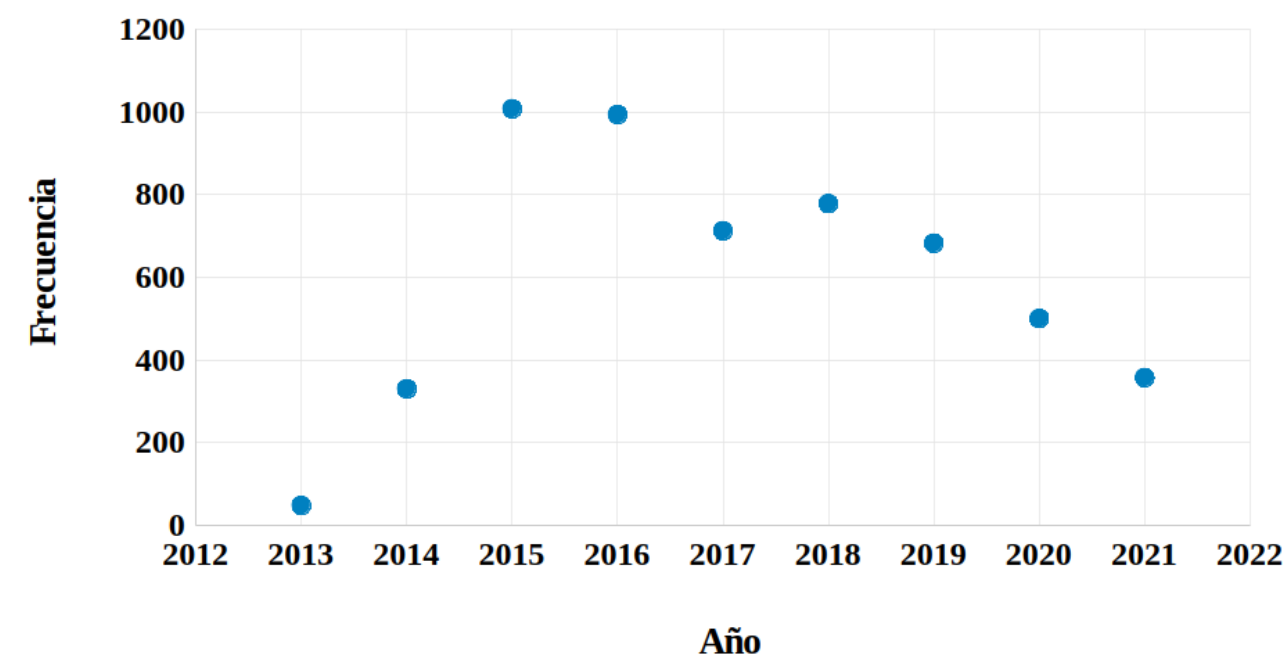
Regarding victim data: 53.49% were heterosexual, 79.03% showed no evidence of alcohol consumption, 11.06% were heads of households, 6.05% had a history of violence, and 1.29% reported the use of psychoactive substances. Regarding data on the aggressors: 70.58% were female. For the years 2020 and 2021, a lower number of cases were reported compared to the years 2015 and 2016. Pregnant women accounted for 36.2% of all victims of domestic violence and 47.5% of victims of gender-based violence. The mortality reported in this study was 0.18%, of which 80% occurred due to negligence and abandonment and 20% due to physical violence; 60% corresponded to the female gender. In this study, cases of patients treated for gender-based and domestic violence are described, as well as the different modalities of violence. Additionally, the determinants of this public health event of interest in Casanare are identified and examined, serving as a starting point for the formulation of management strategies based on prevention.
Author Biographies
Myriam Tatiana Medina Bernal, Centro de Atención e Investigación Médica (CAIMED)
Médica Especializada en Epidemiología y gerencia de salud publica, con Maestría en epidemiología, labora Gerente Médica del Centro de Atención e Investigación Médica sede Yopal Casanare. Es la Presidente del CEIS, Comité de Ética en Investigación en Salud, del Hospital Regional de la Orinoquía ESE.
Luis Carlos Avellaneda Curcho, Hospital Regional de la Orinoquía
Médico Cirujano, labora como médico de urgencias y hospitalario del area de neurocirugía en el Hospital Regional de la Orinoquía. Es investigador, asesor y escritor del grupo de investigación GIHoro reconocido por Minciencias y es asesor en investigación del proceso de investigacion del Hospital Regional de la Orinoquía ESE
Mónica Liseth Holguín Barrera, Hospital Regional de la Orinoquía
Médica Cirujana, Especialista en Epidemiología, labora en la Unidad de cuidado Intermedio Neonatal, del Hospital Regional de la Orinoquía. hace parte del grupo de investigación GIHoro reconocido por Minciencias y es asesora en investigación y escritora del proceso de investigación del Hospital Regional de la Orinoquía.
References
1. López-Hernández E, Rubio-Amores D. Reflexiones sobre la violencia intrafamiliar y violencia de género durante emergencia por COVID-19. CienciAmérica. 2020; 9(2): 312-321. http://dx.doi.org/10.33210/ca.v9i2.319
2. Bandura A. Análisis del aprendizaje social de la agresión. En: Bandura A, Ribes E, editores. Modificación de Conducta. Análisis de la agresión y la delincuencia. México: Trillas; 1975. p. 307-350. Disponible en: https://www.conducteam.com/recursos-libros/modificacion-de-conducta-analisis-de-la-agresion-y-la-delincuencia/
3. Instituto Nacional de Salud. Protocolo de vigilancia en salud pública. Violencia de género e intrafamiliar. 2019. Disponible en: https://www.ins.gov.co/buscador-eventos/Lineamientos/Pro_violencia%20genero.pdf
4. Pereda N, Tamarit JM. (2019). ¿Ciegos ante la perspectiva de género o ciegos ante la evidencia empírica sobre la violencia en las relaciones de pareja? Comentario a Ferrer-Pérez VA y Bosch-Fiol E. Anuario de Psicología Jurídica. 2019; 29(1):85-87. https://doi.org/10.5093/apj2019a6
5. Jaramillo-Bolívar CD, Canaval-Erazo GE. Violencia de género: Un análisis evolutivo del concepto. Universidad y Salud. 2020; 22(2):178-185. https://doi.org/10.22267/rus.202202.189
6. Namy S, Carlson C, O'Hara K, Nakuti J, Bukuluki P, Lwanyaaga J, et al. L. Towards a feminist understanding of intersecting violence against women and children in the family. Soc Sci Med. 2017 Jul; 184:40-48. https://doi.org/10.1016/j.socscimed.2017.04.042
7. Cuenca ML, Graña JL. Factores de riesgo psicopatológicos para la agresión en la pareja en una muestra comunitaria. Clínica y Salud. 2016; 27(2):57-63. https://doi.org/10.1016/j.clysa.2016.04.001
8. Aguayo F, Barker G, Keijzer BD, Duarte Quapper K, Figueroa Perea JG, Franzoni, J, et al. Masculinidades y políticas públicas: involucrando hombres en la equidad de género. Chile: Universidad de Chile; 2011. Disponible en: http://repositorio.ciem.ucr.ac.cr/jspui/handle/123456789/289
9. Organización Mundial de la Salud. Respeto a las mujeres: prevención de la violencia contra las mujeres. Ginebra: Organización Mundial de la Salud; 2020. Disponible en: https://apps.who.int/iris/handle/10665/337198
10. Estupiñán Rodríguez N, Machín Guevara Y, Monzón González J, Rodríguez Hernández E. Caracterización médico legal del homicidio en víctimas femeninas: Matanzas (Cuba). 2013-2018. Antistio Rev. Cient. INMLCF Colomb. 2020;7(1):1-19. https://doi.org/10.16925/2145-9649.2020.01.02
11. Sarmiento CA, Hernández JC. Violencia intrafamiliar contra niñas y adolescentes mujeres en Colombia, 2015-2019. 83-112. Masatugó. Disponible en: https://www.medicinalegal.gov.co/cifras-estadisticas/masatugo
12. Hahn, CK, Gilmore, AK, Aguayo RO, Rheingold AA. Perinatal intimate partner violence. Obstetrics and Gynecology Clinics of North America. 2018; 45(3):535-547. https://doi.org/10.1016/j.ogc.2018.04.008
13. Silva RP, Leite FMC. Intimate partner violence during pregnancy: prevalence and associated factors. Rev Saude Publica. 2020 Nov 2; 54:97. https://doi.org/10.11606/s1518-8787.2020054002103
14. Berhanie E, Gebregziabher D, Berihu H, Gerezgiher A, Kidane G. Intimate partner violence during pregnancy and adverse birth outcomes: a case-control study. Reprod Health. 2019; 16(22):1-9. https://doi.org/10.1186/s12978-019-0670-4
15. Bott S, Ruiz-Celis AP, Mendoza JA, Guedes A. Co-occurring violent discipline of children and intimate partner violence against women in Latin America and the Caribbean: a systematic search and secondary analysis of national datasets. BMJ global health. 2021; 6(12):e007063. http://dx.doi.org/10.1136/bmjgh-2021-007063
16. Armfield JM, Gnanamanickam ES, Johnston DW, Preen DB, Brown DS, Nguyen H, et al. Intergenerational transmission of child maltreatment in South Australia, 1986-2017: a retrospective cohort study. Lancet Public Health. 2021;6(7):e450-e461. https://doi.org/10.1016/s2468-2667(21)00024-4
17. Herrera Merchán EJ, Cañas Betancourt, DC, González Clemente EC, Uribe Ochoa C, Padilla Reyes LA. Caracterización psicosocial en una muestra de mujeres víctimas de violencia de género en Colombia: un estudio piloto. I+ D Revista de Investigaciones. 2020; 15(2): 135-147. https://doi.org/10.33304/revinv.v15n2-2020012
18. Quintero Suárez L, Medina Osorio JC. Exámenes médico legales en mujeres por presunto delito sexual en Colombia, 2015-2019. Masatugó. 2020. p. 225-266.. Disponible en: https://www.medicinalegal.gov.co/cifras-estadisticas/masatugo
19. Escribano, CRL. Violencia y género en América Latina. Pensamiento iberoamericano. 2008; (2):71-91. Disponible en: https://dialnet.unirioja.es/servlet/articulo?codigo=2873321
20. Perras N, Sternfeld I, Fei S, Fischer B, Richards G, Chun K. Analysis of Domestic Violence Related Homicides in Los Angeles County: Media Portrayals, Demographics, and Precipitating Circumstances. J Fam Violence. 2021; (36):629-636. https://doi.org/10.1007/s10896-020-00202-z
21. Su Z, Cheshmehzangi A, McDonnell D, Šegalo S, Ahmad J, Bennett B. Gender inequality and health disparity amid COVID-19. Nurs Outlook. 2022; 70(1):89-95. https://doi.org/10.1016/j.outlook.2021.08.004
22. Ortiz Calle ME. Violencia de género. Revista Nuevo Derecho. 2013; 12: 57-67. https://doi.org/10.25057/2500672X.634
23. Organización Panamericana de la Salud. La violencia contra la mujer. Estrategia y plan de acción sobre el fortalecimiento del sistema de salud para abordar la violencia contra la mujer. 2015. Disponible en: https://www.paho.org/es/temas/violencia-contra-mujer
24. Londoño Toro B, Rubio Lamia LO, Castro Castañeda JF. La violencia de género no tiene fronteras. Estudio comparativo de las normativas colombiana y española en materia de violencia de género (2004-2014). Revista Derecho del Estado. 2017; (38):127-154. Disponible en: https://dialnet.unirioja.es/servlet/articulo?codigo=6178663
How to Cite
Downloads
Downloads
Published
Issue
Section
License
Copyright (c) 2025 Antistio: revista científica del Instituto Nacional de Medicina Legal y Ciencias Forenses de Colombia

This work is licensed under a Creative Commons Attribution-NonCommercial-ShareAlike 4.0 International License.
| Article metrics | |
|---|---|
| Abstract views | |
| Galley vies | |
| PDF Views | |
| HTML views | |
| Other views | |