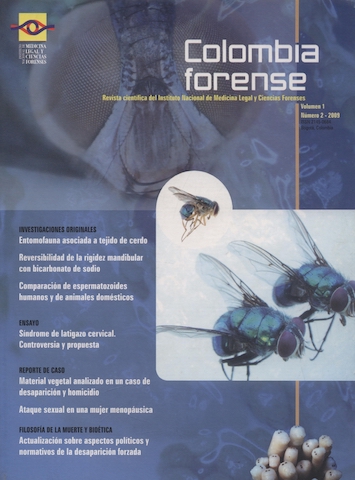
Reversibility of the mandibular rigor mortis in human dead body using sodio bicarbonate at different temperatures, Bogotá
DOI:
https://doi.org/10.60007/antistio.4781Keywords:
rigor mortis, sodium bicarbonate, temperature, lactic acid, muscle contraction, autopsy oral, human identificationAbstract
Background: The limitation in mouth opening in human cadavers with rigor mortis interferes with the process of human identification. Objective: Improve mouth opening conditions induced by sodium bicarbonate 0.01 M at 12°C and 37ºC in human NN dead body with mandibular rigor mortis to facilitate the process of postmortem identification. Materials and methods: An experimental study ex-alive was made. 40 human dead body NN with rigor mortis in phase state, which entered to the Morgue of Legal Medicine National lnstitute and Forensic Sciences, were divided randomly into 4 groups of 1O subjects, G1 water at 12°C, G2 Water at 37°C, G3 sodium bicarbonate 0.01 M 12°C and G4 sodium bicarbonate 0.01 M at 37°C. Initial mouth opening was measured, after this, every 15 minutes from the inoculation until to complete 3 hours. 5 cc of the aforementioned solution was inoculated extraorally into the temporal and masseter muscles bilaterally and simultaneously. Results: The G4 had an opening of 31.5 ± 7.8mm, 60 minutes after inoculation and G3 had an opening of 30.6 ± 5.4mm, 180 minutes after inoculation, finding significant differences among the 4 groups, with a p value < 0.05. Conclusions: The process of reversing the mandibular rigor mortis through the inoculation of 0.01 M sodium bicarbonate at 37°C into the muscles of mastication, becomes a rapid, cheap and easy method to achieve useful mouth opening, amid to make dental examination postmortem.
Author Biographies
Erika Johanna Usme Botello, Pontificia Universidad Javeriana
Odontóloga Colegio Odontológico Colombiano. Estudiante segundo año posgrado odontología legal y forense, Pontificia Universidad Javeriana.
Jenny Raquel Garzón Laverde, Pontificia Universidad Javeriana
Odontóloga Colegio Odontológico Colombiano. Estudiante segundo año posgrado odontología legal y forense, Pontificia Universidad Javeriana.
Isabel Riveros Toledo, Universidad Nacional de Colombia
Directora de tesis. Toxicóloga forense, Universidad Nacional de Colombia.
Gloria Cristina Moreno Toledo, Pontificia Universidad Javeriana. Bogotá D.C.
Asesora metodológica, Pontificia Universidad Javeriana. Bogotá D.C.
References
República de Colombia. Ley 38 de 1993. Artículo cuarto.
Instituto Nacional de Medicina Legal y Ciencias Forenses. Guía práctica para el Dictamen Odontológico Forense. Bogotá. Noviembre de 2004.
Nakayama Y., Aoki Y., Niitsu H., Saigusa K. Forced oral opening for cadavers with rigor mortis: two approaches for the myotomy on the temporal muscles. Forensic Science lnternational 118 (2001) 37-42. https://doi.org/10.1016/S0379-0738(00)00371-6
Calabuig, Gisgert Juan Antonio; Medicina Legal y Toxicología. Salvat Editores S.A., Cuarta Edición. España, 1991. pág. 150
Dimaio, Vincent, Dimaio Dominic. Forensic Pathology. 2da. Edición. CRC press. USA, 2001. Pág. 28-29
Moya, V., Odontología legal y forense, Primera edición. Editorial. Masson S.A. Barcelona 1994.
Aparicio, D. Enríquez, L. Reversibilidad de la rigidez cadavérica mandibular por medios químicos. Tesis de grado facultad de odontología Pontificia Universidad Javeriana. 2005
Fernández, J. Hernández, P. Tovar, M., Reversibilidad de la rigidez cadavérica mandibular por medio del bicarbonato de sodio en humanos. Tesis de grado facultad de odontología Pontificia Universidad Javeriana. 2006
Jacques Levraut, MD; Carine Giunti, MD; Jean- Pierre Ciebiera, MD; Georges de Sousa, PhD; Roger Ramhani, PhD; Patrick Payan, PhD; Dominique Grimaud, MD. Initial effect of sodium bicarbonate on intracellular pH depends on the extracellular non bicarbonate buffering capacity, Crit Care Med 2001.Vol. 29, No.5 https://doi.org/10.1097/00003246-200105000-00032
How to Cite
Downloads
Downloads
Published
Issue
Section
License
Copyright (c) 2024 Antistio: Revista del Instituto Nacional de Medicina Legal y Ciencias Forenses de Colombia

This work is licensed under a Creative Commons Attribution-NonCommercial-ShareAlike 4.0 International License.
| Article metrics | |
|---|---|
| Abstract views | |
| Galley vies | |
| PDF Views | |
| HTML views | |
| Other views | |